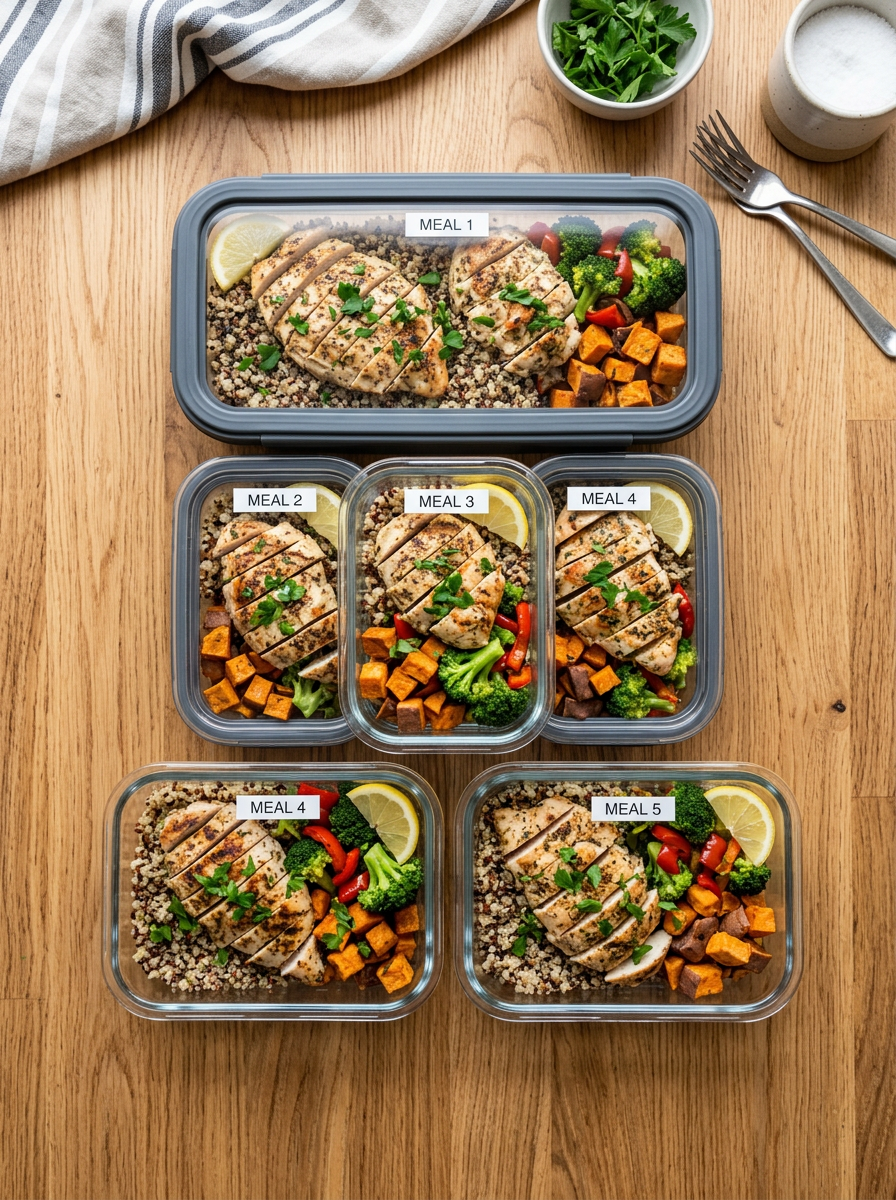
Sunday meal prep has a problem most guides do not address honestly: you spend two hours in the kitchen and end up with five identical containers that you are sick of by Tuesday. The solution is not to prep less — it is to prep components rather than finished bowls. Chicken and quinoa cooked separately and assembled in five different configurations means you are eating a Greek bowl on Monday, a teriyaki bowl on Tuesday, and a Mexican bowl on Wednesday — same prep session, genuinely different meals.
This recipe is built for anyone who wants five days of high-protein lunches or dinners without cooking during the week. Each bowl delivers around 48 grams of protein, complex carbohydrates from the quinoa, and a macro profile that supports sustained energy rather than the mid-afternoon crash that follows a pasta or sandwich lunch. The total prep time is about 45 minutes, mostly hands-off while the quinoa cooks and the chicken roasts.
In this post you will learn how to cook quinoa so it is fluffy and holds up through five days in the fridge, the exact chicken seasoning and temperature that makes meal-prepped chicken taste good reheated, how to build five different bowl variations from one batch of components, how to layer containers to prevent sogginess, the storage window and reheating method that preserves texture, and why the protein content of this combination is particularly effective for appetite control through the afternoon.
15 mins
30 mins
45 mins
5 (5 bowls)
Easy
485 kcal
48g
42g
12g
5g
The Component Method: Why It Beats Assembling Five Identical Bowls
Most meal prep guides tell you to build five complete, identical bowls and seal them. The problem is psychological and practical: identical food gets boring fast, and anything with a dressing or sauce turns soggy by day three. The component method keeps ingredients separate in the container — protein in one section, grain in another, vegetables in a third — and you add sauce or dressing at serving time. This extends the appealing texture window to the full five days and gives you enough flexibility to eat genuinely different things each day.
The components for this batch are roasted chicken thighs, cooked quinoa, and a selection of fresh or roasted vegetables. Each component is seasoned simply, which is what makes them versatile — neutral components accept different sauces well, while pre-sauced components commit you to one flavour profile for the whole week. Keep the base components clean and add flavour at serving time.
Cooking Quinoa That Stays Fluffy for Five Days
Quinoa that turns mushy in meal prep containers is almost always the result of too much water or not fluffing it correctly after cooking. The correct ratio is 1 part quinoa to 1.75 parts water — not the 2:1 that many packages suggest. Rinse the quinoa in cold water first to remove the saponin coating, which causes bitterness. Bring to a boil, reduce to the lowest possible heat, cover tightly for 15 minutes, then remove from heat and leave covered for five more minutes before fluffing with a fork. Do not lift the lid before the resting period is done.
Cool the quinoa completely before putting it in containers — this is essential. Hot quinoa in a sealed container creates steam, which turns it gummy and accelerates spoilage. Spread it on a baking tray for 15 minutes to cool quickly, then containerise. Properly cooked and cooled quinoa keeps well for five days with no texture loss, which is genuinely uncommon among grains.
Roasting Chicken That Reheats Well
Chicken breast is the standard meal prep protein choice, but chicken thighs are significantly better for this application. Thighs have a higher fat content — around 8 to 10 grams of fat per 100g versus 3 to 4 for breast — which means they stay moist through refrigeration and reheating. Breast can turn dry and cottony after three days in the fridge; thighs do not. Bone-in skin-on thighs roasted at 210°C for 30 to 35 minutes, then shredded or sliced, hold up perfectly for five days.
Season simply: olive oil, garlic powder, smoked paprika, salt, and black pepper. This neutral, savoury base works with Greek dressing, teriyaki sauce, a tahini drizzle, or a Mexican salsa — which is the point. Monitoring the internal temperature accurately makes the difference between chicken that is juicy at day five and chicken that was overcooked on Sunday. The ThermoPro TwinTempSpike Bluetooth Thermometer is particularly useful for a batch of six thighs because each one will finish at a slightly different time — monitoring them individually from your phone means you pull each one exactly at 74°C rather than guessing with a single probe and pulling the whole tray at once.
Why This Combination Is Exceptionally Good for Appetite Control
Chicken thigh and quinoa together create an unusually effective satiety profile. Quinoa is one of the few plant-based complete proteins, providing all nine essential amino acids alongside its carbohydrate content — 8 grams of protein and 5 grams of fibre per cooked cup. Combined with the high-quality animal protein from the chicken, a single bowl delivers 48 grams of protein and 5 grams of fibre, which strongly activates both cholecystokinin (the satiety hormone that signals fullness) and the slower-acting peptide YY. In practical terms, this combination genuinely suppresses appetite for four to five hours, which is significantly longer than a carbohydrate-forward lunch.
The practical outcome is fewer calories consumed later in the day, not through willpower but through actual hormonal signalling. For a broader framework on building a whole week around meals like this, the chicken meal prep bowl guide covers the full system, including which vegetables hold up best through five days and how to sequence the batch cooking efficiently.
Container Strategy: How to Prevent Soggy Bowls
The order of layering matters. In a divided container, quinoa goes in first — it is the most absorbent component and benefits from being at the bottom. Chicken goes on top or in a separate section. Vegetables that are roasted (sweet potato, broccoli, bell pepper) go directly into the container while still warm and then cooled. Fresh vegetables (cucumber, tomatoes, avocado) should never be added until serving day — they release water and make the container contents soggy within 24 hours.
Keep sauces in a small separate container that travels alongside. This adds 20 seconds to serving time and completely solves the sogginess problem. Undressed bowls stay appealing for five full days. Dressed bowls start deteriorating within eight hours. The Taima Titanium Nutri Pan Pro 2.0 handles the roasting of vegetables for five bowls in one batch without PFAS coating concerns — important when the pan is going into a 210°C oven for 25 minutes and you are thinking about what is in the coating of a standard non-stick pan.
Five Bowl Variations From One Batch
The base components — seasoned roasted chicken, fluffy quinoa, roasted vegetables — work with any of these five sauce or topping configurations: Greek (cucumber, cherry tomatoes, olives, feta, lemon-oregano dressing); teriyaki (edamame, shredded carrot, sesame seeds, teriyaki glaze); Mexican (black beans, corn, jalapeño, coriander, lime juice); Mediterranean (roasted red peppers, artichokes, sun-dried tomatoes, tahini); or simply a soft-boiled egg and a few spoonfuls of hummus for a quick Middle Eastern angle. Each variation takes under two minutes to assemble at serving time using the base components.
Varying the bowl each day eliminates the monotony that derails most meal prep routines by Wednesday. The components feel like building blocks rather than a commitment to a single dish, which keeps the habit sustainable week after week. The 52-Week High-Protein Meal Prep Cookbook extends this approach to every week of the year with full shopping lists, batch schedules, and variation sets that rotate seasonally — genuinely useful if you want the planning work to disappear.
Cooking chicken thighs for five-day meal prep in a PFAS-free titanium pan that can go from stovetop to oven without coating breakdown is one of those small decisions that makes a healthy eating routine actually consistent rather than aspirational. The full breakdown is at Titanium Cookware That Actually Works (2025) — covering what sets pure titanium apart and which pieces to prioritize first.
Meal Prep Chicken and Quinoa Bowls
Five high-protein bowls prepped in 45 minutes on Sunday — roasted chicken thighs and fluffy quinoa with roasted vegetables, designed to keep the full five days and support five different flavour variations with zero additional cooking.
Ingredients
Chicken
- 5 bone-in, skin-on chicken thighs (about 150g each)
- 1 tsp olive oil
- 1 tsp smoked paprika
- 1 tsp garlic powder
- ½ tsp salt
- ¼ tsp black pepper
Quinoa
- 350g (2 cups) dry quinoa, rinsed
- 600ml (2.5 cups) cold water
- ½ tsp salt
Roasted Vegetables (base)
- 2 medium sweet potatoes, cubed (2cm)
- 2 medium courgettes, sliced into half-moons
- 1 red bell pepper, sliced
- 1 tbsp olive oil
- Salt, pepper, and garlic powder to taste
Instructions
- Preheat oven to 210°C (410°F). Season chicken thighs with olive oil, paprika, garlic powder, salt, and pepper. Place skin-side up on a baking tray. Roast for 30 to 35 minutes until skin is golden and crispy and internal temperature reads 74°C (165°F) at the thickest point.
- On a second tray, toss the sweet potato, courgette, and bell pepper with olive oil, salt, pepper, and garlic powder. Roast at the same temperature for 22 to 25 minutes, tossing once at the halfway point, until caramelised at the edges.
- While everything roasts, rinse the quinoa thoroughly in cold water. Combine with water and salt in a saucepan. Bring to a boil, reduce to lowest heat, cover tightly, and cook for 15 minutes. Remove from heat and let sit covered for 5 more minutes.
- Fluff the quinoa with a fork and spread on a baking tray to cool completely — at least 15 minutes. Do not skip this step.
- When the chicken has rested for 5 minutes, remove the skin and shred or slice the meat off the bone.
- Divide the quinoa, chicken, and vegetables evenly between five airtight containers. Keep sauce or dressing separate in small side containers. Seal and refrigerate.
Notes
Storage: Sealed containers keep in the fridge for 5 days. Reheat in the microwave at 70% power for 90 seconds with a splash of water, or in a pan over medium heat for 3 minutes. Add fresh toppings and sauce after reheating.
Substitutions: For a dairy-free version, all components are already dairy-free. For a vegan version, replace chicken with 400g of baked tempeh or two tins of drained chickpeas roasted with the same seasoning — protein drops to around 28g per bowl but remains substantial.
Chicken thighs over breast: Thighs stay moist through 5 days of fridge storage and reheating. Breast can dry out significantly by day 3. The fat content is the difference — do not substitute breast for convenience.
Beginner tip: The most important step is cooling the quinoa completely before containerising. Steam in a sealed container makes quinoa gummy and shortens its fridge life. 15 minutes spread on a tray is worth the wait.
Tools & Resources
- ThermoPro TwinTempSpike Bluetooth Thermometer — monitors multiple chicken thighs individually from your phone so each one hits exactly 74°C before pulling, not a batch estimate.
- Taima Titanium Nutri Pan Pro 2.0 — oven-safe to high temperatures without PFAS coating risk, consistent with the clean-eating philosophy of a meal prep built around whole ingredients.
- Taima Titanium Cutting Board Set — non-porous surface for cutting raw chicken and prepped vegetables without cross-contamination risk during a high-volume prep session.
- 52-Week High-Protein Meal Prep Cookbook — a full year of structured batch cooking around exactly this format, with week-by-week shopping lists and macro targets that make the planning effortless.
Three decisions make this meal prep reliable across a full week: roasting chicken thighs rather than breast preserves moisture through five days of fridge storage and reheating; cooling the quinoa completely before sealing prevents the steam condensation that turns grains gummy overnight; and keeping sauces separate rather than pre-dressing the bowls allows genuine daily variation from a single Sunday session. Together these choices turn what is often a monotonous or short-lived meal prep into something that is actually good to eat on Friday.
Leave a Reply