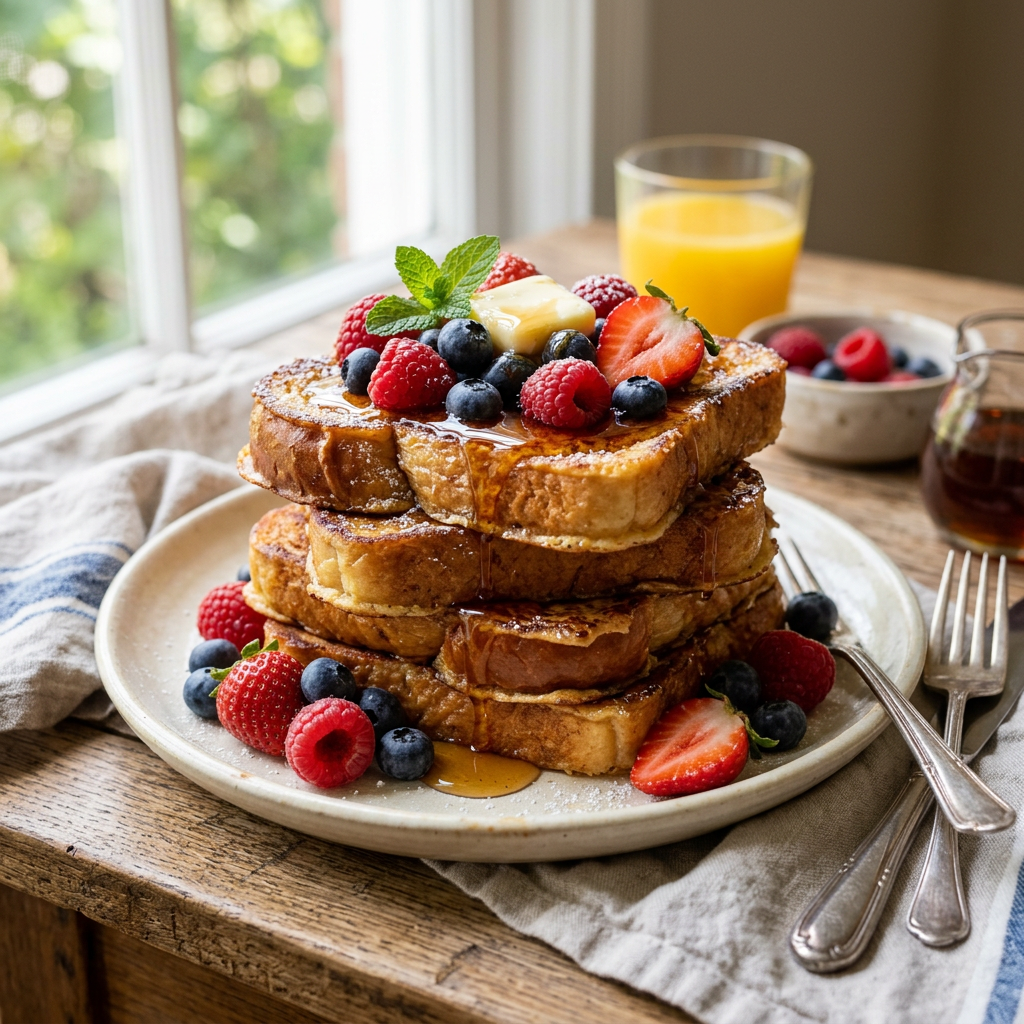
French toast recipe produces one of two results depending entirely on the bread and custard ratio: a slice that is golden on both sides with a soft, almost pudding-like interior that is warm all the way through, or a slice that is golden on the outside and eggy-wet or rubbery in the middle. The difference is not technique. It is bread choice, how stale that bread is, and how long it soaks in the custard.
If you are learning to cook breakfast and want something that takes ten minutes, uses ingredients already in the kitchen, and produces a result that makes people genuinely excited to sit down at the table — this is it. French toast is also one of the best recipes for understanding how eggs behave under heat, which is a piece of knowledge that applies directly to scrambled eggs, omelettes, quiche, and every custard-based dessert.
In this post you will learn why stale bread produces better French toast than fresh, the bread choice that makes the most significant difference, the custard ratio that produces a custardy interior rather than an eggy one, the half-butter-half-oil technique that produces golden edges without the butter burning, medium heat as the non-negotiable, and the toppings and variations worth trying beyond maple syrup.
5 mins
12–16 mins
~20 mins
2–3 (6 thick slices)
Easy
The Bread: Why This Is the Most Important Decision
Brioche is the best bread for French toast. It is an egg-and-butter-enriched bread that is already halfway to a custard by the time you dip it — slightly sweet, rich, and structurally open in a way that absorbs the egg mixture evenly throughout the slice rather than only at the surface. When cooked, brioche French toast produces a golden exterior and a genuinely soft, custardy interior that standard sandwich bread cannot approach.
Challah is the second-best option — similar structure to brioche, slightly less rich, and often easier to find. Texas toast (thick-sliced white bread) works well and produces a more traditional diner-style result. Standard supermarket sandwich bread makes acceptable French toast but the thin slices do not provide enough interior for the custard to work in, and the result tends toward eggy rather than custardy.
The thickness of the slice matters enormously. Cut at least 1 inch thick — ideally 1.25 inches. A thick slice provides enough interior volume for the custard to penetrate without fully saturating, leaving a warm, soft, almost pudding-like centre surrounded by a crisped exterior. Thin slices cook through before the exterior has time to develop proper colour and produce a limp, pale result.
Why Stale Bread Is Better Than Fresh
This is the piece of information that most beginner French toast recipes either omit or mention as a footnote. Day-old or slightly stale bread absorbs the custard more efficiently than fresh bread and without becoming soggy. Fresh brioche is so moist internally that adding custard to it produces a bread that is wet all the way through — the exterior may look golden but the inside is sodden.
Slightly stale bread has lost some of its internal moisture. This creates space — literally — for the custard to absorb into the bread’s structure rather than simply sitting on the surface. The egg proteins then coagulate around that absorbed custard during cooking, producing a firm-yet-soft, custardy interior rather than a wet, eggy one.
If your brioche or challah is fresh, slice it the day before and leave it uncovered overnight at room temperature. Or cut thick slices and place them on a baking rack in a 300°F oven for ten to fifteen minutes until they feel slightly dried on the surface. Either method produces the right starting point for perfect French toast.
The Custard: More Than Just Egg and Milk
The custard is what makes French toast French toast rather than just fried bread. The ratio that produces the best result: three eggs and three-quarters of a cup of whole milk or half-and-half for six thick slices of brioche. This provides enough custard to coat every slice fully without thinning the mixture to the point where it tastes of little beyond egg.
Full-fat milk produces a noticeably richer result than low-fat or skimmed. Half-and-half (half cream, half milk) or heavy cream produces the richest possible version — the extra fat prevents the custard from setting too firmly during cooking and keeps the interior genuinely soft rather than firm and bouncy.
Beyond the egg and milk: a teaspoon of vanilla extract adds warmth and rounds the flavour. A half teaspoon of cinnamon adds the spice note that most people associate with French toast. A tablespoon of sugar dissolved into the custard lightly sweetens the bread itself rather than relying entirely on the maple syrup. A pinch of salt prevents the custard from tasting flat.
Whisk until completely combined — no visible egg white streaks. Strain through a fine mesh sieve if you are particular about texture. Pour into a wide, shallow dish rather than a deep bowl — the bread needs to lie flat in the custard to absorb evenly.
The Soak: How Long Is Exactly Right
Dip each slice of brioche into the custard and let it sit for thirty to sixty seconds per side. This is enough time for the custard to penetrate through the slice without becoming fully saturated. The slice should feel heavy when lifted — custard has been absorbed — but should not be dripping or collapsing.
The most common beginner mistake is a soak that is either too brief (two to three seconds per side — the custard only coats the surface and the inside is dry) or too long (several minutes — the bread is completely saturated and collapses, producing an impossible-to-cook, soggy interior). Thirty seconds per side is the right starting point for 1-inch thick brioche.
For thicker slices, increase the soak time to forty-five to sixty seconds per side. For thinner slices, reduce to fifteen to twenty seconds. The visual cue: the slice should look slightly translucent at the cut edges from custard absorption, but should still hold its shape firmly when picked up.
Half Butter, Half Oil: The Technique That Prevents Burning
Cooking French toast in butter alone produces burning — the milk solids in the butter scorch at the moderate temperature French toast needs to cook through before the exterior browns. By the time the inside is properly cooked, the butter has turned dark and the bottom of the French toast has a bitter, slightly acrid note.
The solution is a 50/50 mixture of unsalted butter and neutral oil. The butter provides the flavour and richness that makes French toast taste like French toast. The oil raises the smoke point of the fat mixture above what butter alone can achieve, allowing the bread to cook at the right temperature — medium heat — for long enough to develop a deep golden colour without the butter burning.
Use one teaspoon of butter plus one teaspoon of neutral oil per two slices. Melt together in the pan over medium heat until the butter foams and the foam begins to subside — this indicates the water from the butter has evaporated and the fat is ready. Add the soaked bread immediately.
Medium Heat: The Only Correct Setting
Medium heat for French toast. Not medium-low — the bread needs enough heat to develop a proper crust in a reasonable time. Not medium-high — the exterior will brown before the interior has warmed through and cooked.
At medium heat, a 1-inch thick slice of brioche takes three to four minutes per side to develop a deep golden colour. This cook time gives the custard inside enough time to set from liquid to soft and custardy — the egg proteins gradually coagulating as the heat penetrates from both sides toward the centre.
The ThermoPro Candy Thermometer clipped to the pan handle is a useful calibration tool — the ideal pan surface temperature for French toast is around 325°F, which corresponds to medium on most home stoves. If you have cooked several batches and the bread is consistently browning faster than the inside can cook, your medium heat is running too hot.
The Right Pan
A wide, flat pan with even heat distribution is essential. French toast cooked in a pan with hot spots browns unevenly — some sections golden, others pale — and produces a result that looks nothing like the restaurant version even when the technique is otherwise correct.
The Taima Titanium Nutri Pan Pro 2.0 is wide enough for two to three slices of brioche at a time, heats evenly so every part of each slice develops the same golden colour simultaneously, and is PFAS-free so nothing leaches into the butter and oil mixture during the moderate-heat cook. For a single portion, the Taima Titanium Everyday Duo compact pan handles two slices at a time with the same even heat.
Toppings and Variations
Classic: warm maple syrup, a dusting of powdered sugar, and fresh berries. The acidity of the berries against the rich, slightly sweet custard bread is genuinely outstanding.
Cinnamon sugar: toss hot French toast in a mixture of two tablespoons of sugar and half a teaspoon of cinnamon immediately after it comes out of the pan. The sugar melts slightly on the hot surface and creates a light, crispy exterior reminiscent of churros.
Caramelised banana: slice a banana lengthways, cook in butter and brown sugar in the same pan for two minutes per side until golden and slightly sticky. Serve over the French toast with a drizzle of cream.
Savoury French toast: omit the sugar, vanilla, and cinnamon from the custard. Add a tablespoon of grated Parmesan and a pinch of dried herbs. Serve with a fried egg on top and a few drops of hot sauce. The same technique applied to an entirely different flavour profile.
For the weekend breakfast that covers every base, French toast alongside a stack of fluffy pancakes is the combination most people only experience at brunch restaurants. The fluffy pancakes guide covers the batter method and rest time that produces the tall, airy stack. Make both simultaneously — batter resting while the first round of French toast cooks — and the total active time is under twenty-five minutes.
For anyone who wants to bake their own brioche from scratch for the best possible French toast base, the Complete Beginner’s Guide to Mastering Breads, Cakes, Cookies and Pastries covers the brioche dough technique — the enriched yeast dough that is both the best bread for French toast and one of the most impressive things you can learn to bake.
Classic French Toast
Thick-sliced day-old brioche soaked in a vanilla-cinnamon egg custard with whole milk, cooked in a half-butter-half-oil mixture at medium heat until deeply golden outside and soft and custardy inside. Served with maple syrup, powdered sugar, and fresh berries.
Ingredients
The Custard
- 3 large eggs
- 180ml (3/4 cup) whole milk or half-and-half
- 1 tsp vanilla extract
- 1/2 tsp ground cinnamon
- 1 tbsp granulated sugar or brown sugar
- Pinch of salt
The Bread
- 6 slices brioche or challah, cut 1 to 1.25 inches thick, day-old or lightly dried
For the Pan (per batch of 2 slices)
- 1 tsp unsalted butter
- 1 tsp neutral oil (vegetable or sunflower)
To Serve
- Warm maple syrup
- Powdered (icing) sugar, dusted
- Fresh berries (strawberries, blueberries, raspberries)
Instructions
- Make the custard: whisk eggs, milk, vanilla, cinnamon, sugar, and salt in a wide, shallow dish until completely combined with no visible white streaks. Set aside.
- If your brioche is fresh: place slices on a baking rack in a 300°F oven for 10 minutes to dry the surface slightly. Cool before dipping. If day-old, proceed directly.
- Soak the bread: lay two slices of brioche in the custard. Soak for 30–45 seconds per side until the custard has visibly absorbed into the bread and the slices feel heavy but still hold their shape. Do not over-soak.
- Cook: heat a wide pan over medium heat. Add 1 tsp butter and 1 tsp oil. When the butter has melted, foamed, and the foam begins to subside, add the soaked slices. Cook undisturbed for 3–4 minutes until the bottom is deeply golden. Flip once and cook the second side for 3–4 minutes. The finished slice should be golden on both sides with a soft, slightly yielding feel when pressed gently in the centre.
- Keep cooked slices warm in a 200°F oven on a baking rack while you cook subsequent batches. Add fresh butter and oil for each batch.
- Serve with warm maple syrup, a dusting of powdered sugar, and fresh berries. Eat immediately.
Notes
Stale vs. fresh: Day-old or slightly dried bread is genuinely better — it absorbs the custard without becoming sodden. If you only have fresh brioche, dry it briefly in the oven first. Do not skip this if using very fresh bread.
Soggy French toast: Over-soaking is the primary cause. Thirty seconds per side for 1-inch brioche is the right amount. Reduce the soak for thinner slices.
Pale, not golden: The pan was not hot enough, or was overcrowded. Ensure the pan is properly preheated before the bread goes in, and cook in batches of two rather than fitting everything in at once.
Butter burning: You are using too much butter without oil, or the heat is too high. The half-butter-half-oil mixture at medium heat prevents this. If the butter is browning immediately when it hits the pan, the heat is too high.
Beginner tip: The soak time is the most important variable to get right. Set a timer for 30 seconds per side for your first batch and judge the result — too eggy and wet means extend the soak slightly next time; too dry in the middle means extend the cook time slightly at lower heat.
Tools & Resources
- Complete Beginner’s Guide to Mastering Breads, Cakes, Cookies and Pastries — learn to bake your own brioche from scratch for the very best possible French toast base
- ThermoPro Candy Thermometer — clip to the pan handle to verify the pan is at the ideal 325°F French toast temperature before each batch goes in
- Taima Titanium Nutri Pan Pro 2.0 — wide, PFAS-free, even-heating pan that browns both slices in a batch simultaneously without hot spots that produce patchy colouring
- Taima Titanium Everyday Duo — the compact pan in this set handles two slices at a time for a single portion, with the same even heat and PFAS-free surface for everyday breakfast cooking
A great French toast recipe is built on three decisions made before the pan heats up. Use thick-cut brioche or challah — the enriched bread absorbs the custard completely without collapsing, providing the custardy interior that standard sandwich bread cannot. Dry the bread slightly before soaking — day-old bread works best, or ten minutes in a low oven if you only have fresh. And use a half-butter-half-oil mixture in the pan rather than butter alone — the oil raises the smoke point so the French toast cooks at medium heat for the full three to four minutes per side without the butter scorching. The soak timing — thirty to forty-five seconds per side — and medium heat throughout are the two things to hold steady across every batch. Get those right and you will never make pale, soggy, or rubbery French toast again.
The pan you cook French toast in shapes every result — even heat across the full surface at medium temperature so both slices in a batch colour at the same rate, with a non-stick surface that releases cleanly when you flip. If you are thinking about upgrading your kitchen to PFAS-free, non-toxic cookware built for everyday breakfast cooking, the full breakdown is at Titanium Cookware That Actually Works (2025) — covering what sets pure titanium apart and which pieces to prioritize first.
Leave a Reply