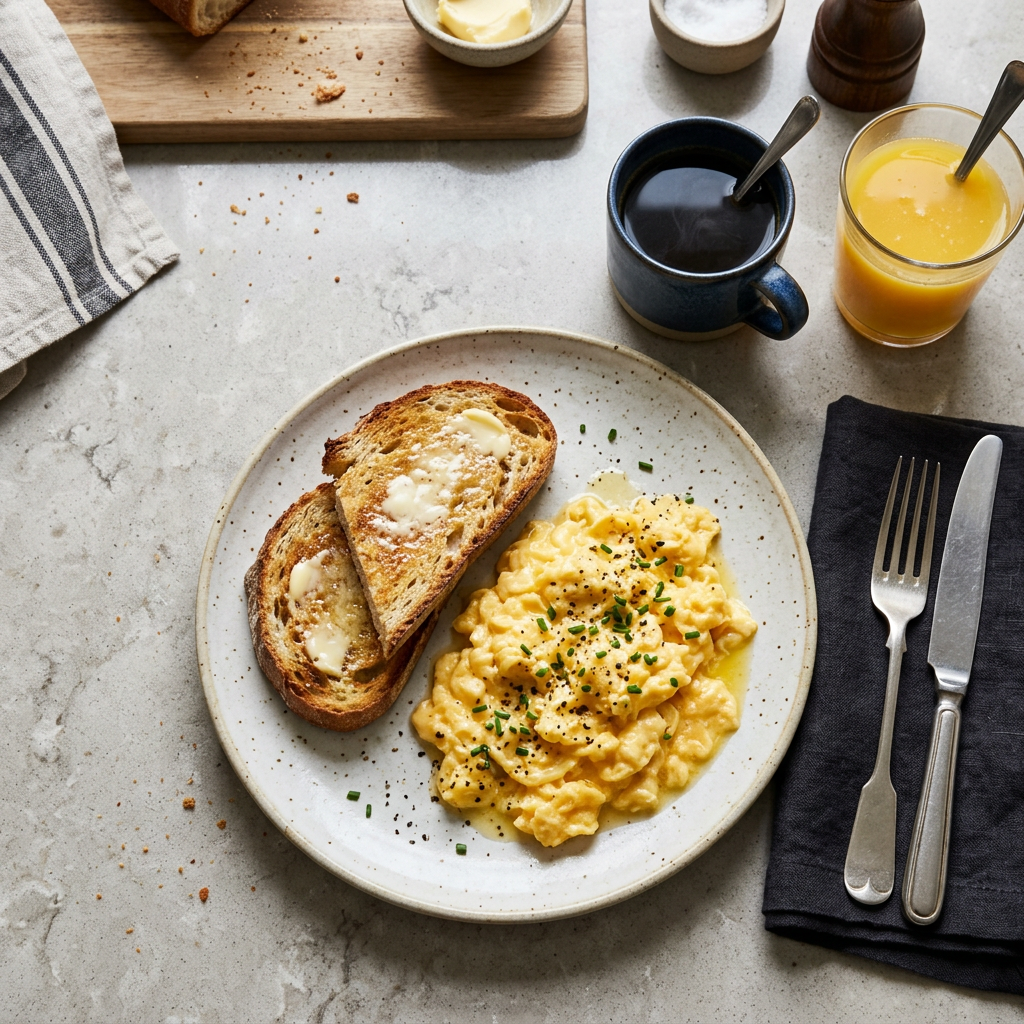
Scrambled eggs recipe sounds like something that requires no instruction. Crack eggs, add heat, stir. Most people cook them this way for years and produce something technically edible but rarely remarkable — pale, slightly rubbery, uniformly dry. The version that comes from a professional kitchen is so different in texture and flavour that it genuinely does not seem like the same dish. The difference is almost entirely heat level and patience.
If you are new to cooking, scrambled eggs are the best possible daily practice recipe. They are cheap, fast, require exactly one pan, and teach you the most important lesson in cooking: gentle heat produces better results than high heat for delicate proteins. Once you cook eggs correctly, you will cook fish better, chicken more carefully, and sauces more attentively. It is the foundational lesson in everything.
In this post you will learn why low heat is non-negotiable, the difference between American and French scrambled eggs and how to make both from the same base, when to add salt, when to add butter, why milk and cream are not what makes eggs creamy, and the finishing touches that turn a simple breakfast into something genuinely good.
2 mins
4–8 mins
~10 mins
1–2
Easy
The Single Biggest Mistake in Every Scrambled Eggs Recipe
High heat is why most scrambled eggs are rubbery. Egg proteins are delicate — they set at relatively low temperatures and continue setting rapidly as temperature rises. A pan on medium-high or high heat brings the eggs to a firm set almost instantly, before the moisture inside the curds has time to remain. The result is a dry, bouncy texture that no amount of butter or cheese can fully rescue once it has happened.
Low to medium-low heat allows the egg proteins to set gradually. The curds form slowly, retain moisture, and produce a texture that is tender, slightly glossy, and genuinely creamy without adding any cream at all. The cook time increases from two minutes to five or six, and every extra minute is worth it.
The same principle explains why steakhouse eggs are so much better than diner eggs — the good ones are cooked slowly with attention, pulled before they look done, and served immediately. The bad ones are blasted with heat and left too long.
American vs. French Scrambled Eggs
American scrambled eggs are cooked over medium-low heat, stirred occasionally with a spatula, and produce soft, billowy, large curds with a fluffy texture. They take four to six minutes and are what most people picture when they think of good scrambled eggs — golden, light, and substantial enough to pile on toast.
French scrambled eggs are cooked over very low heat — sometimes with the pan moving on and off the heat entirely — and stirred almost constantly with a rubber spatula in small circular movements. They produce a completely different result: a loose, silky, barely set custard that holds its shape just enough to eat from a plate. They look underdone to most people and taste extraordinary. They take eight to ten minutes and require patience.
Both methods start from the same beaten egg base. The only variables are heat level and movement frequency. This recipe covers both — choose based on how much time you have and which texture you prefer.
Salt Timing: Before or After?
Salt the eggs before cooking rather than after. This is a widely debated point and the evidence strongly favours pre-salting. Salt added to raw beaten eggs dissolves into the liquid egg and distributes throughout every curd as it forms. Salt added after cooking sits only on the surface and seasons unevenly.
A quarter teaspoon of salt per three eggs, added to the beaten eggs and left to sit for even one minute before cooking, produces a noticeably more evenly seasoned and slightly creamier result. The salt begins to break down some of the egg protein structure, which contributes to the softer final texture. This is the same reason brined meat is juicier than unsalted meat.
White pepper rather than black pepper is preferred by many professional kitchens for scrambled eggs — it distributes invisibly through the curds and has a slightly more subtle, rounded heat than black pepper. Either works; white pepper is worth trying if you have not.
Butter: The Right Amount at the Right Time
Butter is the correct fat for scrambled eggs. Olive oil produces a greasy, slightly heavy result and a flavour that competes with the egg rather than enhancing it. Butter at moderate heat produces a foam that coats the pan evenly and contributes a richness that becomes part of the egg’s overall flavour as the curds cook in it.
Use more butter than feels intuitive — one tablespoon per two to three eggs. This sounds like a lot until you eat the result and compare it to eggs cooked with half the amount. The butter does not make the eggs greasy if the heat is low enough; it makes them rich and tender and slightly glossy at the surface.
Add a small extra knob of cold butter off the heat at the very end, just before serving. It melts into the hot curds and adds a final gloss and richness that is the defining detail of professionally cooked scrambled eggs. This is the same butter-mounting technique that appears in the lemon chicken sauce and the honey garlic chicken — one of the most useful small techniques in cooking.
Milk and Cream: What They Actually Do
Adding milk or cream to scrambled eggs is extremely common and produces a slightly different texture — but not a creamier one. Milk and cream dilute the egg protein, which lowers the temperature at which the eggs set and makes them slightly more prone to becoming watery if overcooked. The foam you see in milk-based scrambled eggs is not creaminess — it is the milk protein cooking separately from the egg.
For the creamiest scrambled eggs, skip the milk and use a teaspoon of crème fraîche or full-fat sour cream stirred in just before the eggs come off the heat. These have a higher fat content than milk, a slightly acidic note that brightens the flavour, and they melt into the curds rather than cooking separately. If you do not have either, a small knob of cold butter at the end achieves a similar result.
If you prefer milk-based eggs — which many people do, particularly for the slightly lighter texture — use whole milk and no more than a tablespoon per three eggs. Any more genuinely does make the eggs watery rather than creamy.
The Pan: Why It Matters for Perfect Scrambled Eggs
Scrambled eggs require a pan that heats evenly at low temperatures and releases the eggs cleanly without sticking. Uneven heat means some sections of the pan are hotter than others — the eggs in the hot spots overcook and turn rubbery while the rest is still underdone.
The Taima Titanium Nutri Pan Pro 2.0 is the right pan for scrambled eggs — PFAS-free, even-heating, and genuinely non-stick at low temperatures without any coating that degrades over time or leaches into food during the repeated gentle heat cycles that scrambled eggs require. Most non-stick pans work with eggs only when they are new; a pure titanium surface maintains its performance indefinitely.
Pan size matters: use a pan that is slightly small for the number of eggs rather than large. A too-wide pan spreads the egg thin, which sets faster than intended and produces flat, dry results rather than pillowy curds. An 8-inch pan for two to three eggs is the right proportion. The Taima Titanium Everyday Duo includes a smaller pan specifically sized for one to three eggs — the compact size builds up the curds rather than spreading them flat.
When to Pull the Pan
Pull the eggs off the heat when they look about 80 percent done — slightly wetter and looser than you actually want them. The residual heat in the pan and the eggs themselves continues cooking them for thirty to sixty seconds after they leave the heat. If you wait until they look perfectly done before removing them, they will be overcooked by the time they reach the plate.
This principle — pulling proteins before they look done and trusting carry-over heat — applies to steak, chicken, fish, and virtually every other protein cooked to temperature. Scrambled eggs are the easiest and cheapest way to learn it daily until it becomes instinct.
Serve immediately. Scrambled eggs do not hold. They continue setting from their own internal heat and become progressively drier with every minute they sit. Have the toast ready, the plate warm if possible, and serve the moment the eggs leave the pan.
Additions and Variations
Cheese: add finely grated Gruyere, sharp cheddar, or Parmesan in the last thirty seconds of cooking, stirring once to incorporate before the eggs come off the heat. The cheese melts into the curds and adds a savoury richness that requires no other addition.
Fresh herbs: chives are the classic addition — fold in finely sliced chives off the heat immediately before serving. They add colour and a mild allium flavour that pairs cleanly with egg. Tarragon, flat-leaf parsley, or dill all work well.
Smoked salmon: place a few pieces of cold smoked salmon alongside or on top of hot scrambled eggs on toast. The contrast between hot, creamy eggs and cold, silky smoked salmon is one of the most satisfying combinations in any breakfast repertoire.
Alongside pancakes: perfectly scrambled eggs next to a stack of fluffy pancakes is the classic weekend breakfast that most people only achieve at a restaurant. The fluffy pancakes guide covers the batter technique that produces the tall, airy stack — make both together and you have a genuinely impressive weekend breakfast in under thirty minutes.
Scrambled Eggs as a Meal Prep Protein
Scrambled eggs are one of the highest-protein, lowest-cost, fastest-cooking protein sources in any kitchen. Three eggs provide roughly 18 grams of protein in under ten minutes for almost no cost. The 52-Week High-Protein Meal Prep Cookbook includes egg-based meals across the week as part of its high-protein framework — not as a meal prep batch (eggs do not hold well) but as the fastest available protein on days when the batch-cooked proteins are not needed.
Perfect Scrambled Eggs — Two Ways
American style: soft, billowy, large curds in four to six minutes over medium-low heat. French style: silky, loose, barely-set custard in eight to ten minutes over very low heat. Both start the same way. Choose based on the time you have and the texture you prefer.
Ingredients
- 3 large eggs
- 1 tbsp unsalted butter (plus an extra small knob for finishing)
- 1/4 tsp salt
- Pinch of white pepper (or black pepper)
- 1 tsp crème fraîche or full-fat sour cream (optional — for extra creaminess)
- Fresh chives or herbs to finish (optional)
Instructions
Base prep (both styles):
- Crack eggs into a bowl. Add salt and pepper. Beat with a fork until the whites and yolks are completely combined and the mixture is uniform in colour — about 30 seconds. Let sit for 1 minute while the pan heats.
- Set pan over the appropriate heat (see below). Add butter. Let it melt and foam without browning.
American style (fluffy curds):
- Heat: medium-low. Pour beaten eggs into foamy butter. Let sit undisturbed for 20–30 seconds until the edges just begin to set.
- Using a rubber spatula, push the eggs from the edges toward the centre in slow, sweeping folds. Let sit another 20 seconds between folds. Repeat, folding gently every 20 seconds.
- When the eggs are about 80% set — still slightly glossy and wetter than you want — remove from heat. Stir in crème fraîche or finishing butter if using. Fold once more from residual heat. Serve immediately.
- Total active cook time: 4–6 minutes.
French style (silky custard):
- Heat: very low (or move the pan on and off the heat every 30 seconds). Pour eggs into foamy butter.
- Stir constantly with a rubber spatula in small circles, keeping the egg moving at all times. The eggs should barely seem to be cooking — very slow, very gradual.
- When the mixture starts to look like a loose, barely-holding custard — cohesive but still wet and silky — remove from heat immediately. Stir in crème fraîche. The carry-over heat finishes it.
- Serve immediately on warm toast. Total active cook time: 8–10 minutes.
Notes
Pull early: Both styles should look about 20% underdone when you take them off the heat. They finish cooking in the pan and on the plate. Waiting until they look done means they will be overcooked when eaten.
Serve immediately: Scrambled eggs do not hold. Have everything else ready before the eggs go in the pan.
No crème fraîche: A small cold knob of butter stirred in off the heat at the end achieves a similar gloss and richness.
Additions timing: Cheese goes in at 80% done, off the heat, folded once. Fresh herbs go on at the very end, after the pan is off the heat. Both preserve maximum flavour this way.
Beginner tip: If your scrambled eggs are rubbery, the pan was too hot. Next time, turn it one notch lower than feels right and add one extra minute to the cook time. You will immediately notice the difference in texture.
Tools & Resources
- 52-Week High-Protein Meal Prep Cookbook — integrate eggs as your fastest weekday high-protein option in a full weekly meal plan built around efficient cooking
- ThermoPro Candy Thermometer — clip to the pan handle to monitor exact surface temperature and keep the pan in the ideal 250–300°F range for perfectly gentle scrambled eggs without guessing
- Taima Titanium Nutri Pan Pro 2.0 — PFAS-free, even-heating pan that stays non-stick at low temperatures indefinitely, without any coating that degrades from the daily gentle heat cycles of egg cooking
- Taima Titanium Everyday Duo — the compact pan in this set is the ideal size for 2–3 eggs, building the curds into the centre rather than spreading them thin across a too-wide surface
Perfect scrambled eggs recipe comes down to two decisions: salt the eggs before cooking so the seasoning distributes through every curd rather than sitting on the surface, and cook over low heat with patience so the proteins set slowly and retain moisture rather than seizing into rubbery toughness. Pull the pan when the eggs look 80 percent done, stir in a small knob of cold butter, and serve immediately — the carry-over heat finishes the remaining 20 percent on the plate. These decisions cost no extra time and produce a result so noticeably better than high-heat scrambled eggs that it changes how you approach every delicate protein you cook from that point forward. Scrambled eggs are the best possible daily teacher in any beginner kitchen.
The pan you cook eggs in matters more for this recipe than almost any other — low, even heat and a genuinely non-stick surface without any coating that degrades over repeated use is the foundation of eggs cooked this gently. If you are thinking about upgrading to PFAS-free, non-toxic cookware built for everyday use including delicate cooking like this, the full breakdown is at Titanium Cookware That Actually Works (2025) — covering what sets pure titanium apart and which pieces to prioritize first.
Leave a Reply